
Friday, September 24, 2010
DO YOU DO CUSTOM HOMES?


Wednesday, September 22, 2010
New Plans Added This Summer 2010
Tuesday, June 1, 2010
Planning Links
Bath Fixtures
American Standard Fixtures
Delta Faucet
Jacuzzi Tubs
Kohler Fixtures
Lasco Bathware
Building Materials
CertainTeed
Chadsworth's Columns
Fypon Vinyl Trim & Moldings
Historic Doors
Home Depot
Lowe's Home Improvement
Lumber Liquidators (Hardwood Flooring)
Construction Network for products
NAILITE
Elevators
LEV Elevators
ThyssenKrupp Access
Waupaca Elevators
Green & Healthy Homes
HealthyBuilt Homes
Kitchen Fixtures
Delta Faucet
GE Appliances
Kitchen-Aide Appliances
Sub-Zero & Wolf Appliances
Lighting
Brass Light Gallery
Permits & Planning
CAMA Permits - North Carolina Division Of Coastal Management
FEMA | Federal Emergency Management Agency
Flood Maps - Digital Flood Insurance Rate Maps
North Carolina Dept. of Environment & Natural Resources
North Carolina Dept. of Insurance - Building Engineering & Codes
North Carolina Licensing Board for General ContractorsReal Estate
Realtor.com
Siding
James Hardie Siding & Trim
Storage Solutions
ClosetMaid
Windows for coastal areas
Anderson Windows
& Doors
Jeld-Wen Windows
Peachtree Windows & Doors
Pella Windows & Doors
Simonton Windows & Doors
Friday, May 14, 2010
2 New Plans Added This Week (May 10-14)
Traditional Homes (Single-Level)


Saturday, May 8, 2010
The Do and Don'ts of Building in Hurricane-Prone Areas
 "The Do and Don'ts of Building in Hurricane-Prone Areas" by NJIT (New Jersey's Science & Technology University) architecture professor Rima Taher, PhD. This is a version of an original press release dated June 15, 2009, but the message is worth repeating.
Taher has written extensively about best building design and construction practices to reduce wind pressures on building surfaces and to resist high winds and hurricanes in residential or commercial construction.
She is a civil/structural engineer who teaches at NJIT’s College of Architecture and Design. Her courses include topics related to wind and earthquakes with guidelines and recommendations for better design and construction in hurricane and earthquake prone areas.
Her recommendations in the forthcoming article should be heeded by anyone building in high wind regions. They include the following.
Design buildings with square, hexagonal or even octagonal floor plans with roofs of multiple slopes such as a four-sloped hip roof. These roofs perform better under wind forces than the gable roofs with two slopes. Gable roofs are common only because they are cheaper to build. Research and testing demonstrate that a 30-degree roof slope will have the best results.
Wind forces on a roof tend to uplift it. “This explains why roofs blow off during extreme wind events,” Taher said. To combat uplift, she advises connecting roofs to walls strongly with nails, not staples. Stapled roofs were banned in Florida after Hurricane Andrew. The use of hurricane clips is recommended. The choice of roofing is important. Different roofing systems perform differently under hurricane conditions. In tile roofs, loose tiles often become wind-borne debris threatening other structures.
Aim for strong connections between the structure and foundation. Structural failure—one structural element triggering the collapse of another—can be progressive.
Hurricane shutters can protect glazing from wind-borne debris. Various designs are available.
Roof overhangs are subject to wind uplift forces which could trigger a roof failure. In the design of the hurricane-resistant home, the length of these overhangs should be limited to about 20 inches.
The design of the researched cyclonic home includes simple systems to reduce the local wind stresses at the roof’s lower edges such as a notched frieze or a horizontal grid. Install the latter at the level of the gutters along the homes’ perimeter.
An elevated structure on an open foundation reduces the risk of damage from flooding and storm-driven water. All foundation piles must be strengthened by bracing and should penetrate deep enough into the soil to reduce the risk of scour."
For Video of Rima Taher, PhD, discussing her findings, go to "http://www.njit.edu/news/2009/2009-224.php"
Friday, April 2, 2010
3 New Plans Added This Week (March 31-April 2)
Traditional Homes (Single-Level)


Tuesday, March 30, 2010

Tuesday, March 9, 2010
NEW! PDF Plans
Adobe ® PDF Files are sent by email to Purchaser and are the FASTEST WAY TO RECEIVE PLANS!
PDF Plans can be printed at most large document print centers such as FedEx Office (formerly known as FedEx Kinko's), or on any large (C to D size) document printer.
Tuesday, February 16, 2010
New plan added: February 15
Under 2,000 S.F. Cottages

Wednesday, February 10, 2010
New Plans Added: February 10
Under 2,000 S.F. Cottages
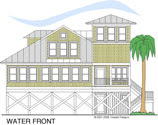
1) Cedar Point 1898-3

2) Pinfish 1825-3
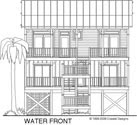
3) Surfside 1536-4
Wednesday, August 12, 2009
Plywood Hurricane Shutters!

Thursday, July 9, 2009
New Plans Added: July 8

1) Surf 1480-4

2) Sand Castle 1080-2
We will keep you posted with upcoming new plans.
Monday, June 15, 2009
100 Top-Requested Building Products Includes 53 Eco-Friendly Picks

From the web site of EcoHome, their sister publication Building Products assembled the top 100 building products from Custom Home, Builder and Remodeling from mailer service cards. Click on the “Building Products” link and find several new products and many old favorites. You’d be surprised what people are interested in putting in their homes today. Energy-Efficiency and Green products are the most requested! It seems people want to buy products to save money, which in most cases means saving energy too! No surprise here.
It’s just that I feel most builders are stuck in the past ways of building. They either don’t know how to add new energy-saving products or are unwilling to move out of their old (if-it-works-don’t-fix-it) way of building. I know there are several innovative builders out there that take charge in presenting new energy-efficient and green products to their buyers. Some builders even take it on themselves to educate new home buyers about the energy efficient life-style. Yes, they probably feel like it’s a waste of time to educate home buyers on energy-efficiency when in most cases it fails to produce a sale.
Nowadays, most Home Buyers want a bargain, or at least if they spend more now on energy-efficient add-ons, they hope it might save money later. The challenge lies in the fact that it is hard to pick a good energy-efficient or “Green” product from the thousands that are coming on the market that will cost less, save money, and last! For your new homes, seek third-party certification such as through LEED for Homes, NAHB Model Green Home Building guidelines, and Energy Star.

I remember all the hoopla about the solar fad back in the 1980’s. I educated myself about solar, even built a few successful projects using direct and indirect solar gain. But when the solar tax credits ran out and winters got warmer, people forgot all about it. People really didn’t seem to understand it anyway. I don’t think it’s like that way now. Solar, Wind, Geo-Thermal, Hydro, Bio-Mass, Hybrid and others are just many ways people are now realizing that it’s not a fad, energy-efficiency is finally here to stay - not only will it save money - but because we have to!
Friday, June 12, 2009
New and Updated Plans: June 12
Under 2,000 S.F. Cottages
* NEW PLAN - Wrightsville 1792-4
* TWO (2) UPDATED PLANS
1) Channel Watch 3887-4E
2) Surf 1754-4
We will keep you posted with upcoming new plans.
Monday, June 8, 2009
What's Wrong or What's Right with Homes Today?

I was surfing the web the other day (I know, what a waste of time) looking for inspiration or new ideas... and actually came across one! I came across an interview with Chris Andreson talking with Watts Wacker & Ethan Zuckerman where a Chinese appliance manufacturer, Haier, was trying to expand their market in rural areas and came across a situation where there was a complaint about cabbage leaves getting stuck in their washing machines. It seems that in rural areas, their washer was being used to wash produce in order to make it better and therefore get a higher price at the market. As it turns out, instead of adding a large notice that their washers shouldn’t be used to clean produce, they added a “produce washing” cycle instead, and therefore added to their market sales.
By watching this video, I thought, “what are some ways people use homes that designers don’t know about?” Therefore, I invite you to send in ideas about ways you use your home, or new ways you would like to use it. What do you use the “Living Room” for? What is the purpose of the “Sunroom?” does doing the laundry spill over into the hall? Would you like to cook more outdoors? Do you exercise in the living room? See what I mean? How do you REALLY use you home, or WANT to use your home? Send me a short reply, I’d really like to know.


